
Enterprise WordPress Solutions: Is WordPress Ready for Large Organizations?
We get this question in almost every discovery call: “Isn’t WordPress just for blogs and small business sites?”
The evidence tells a different story. NASA.gov runs on WordPress. It serves decades of mission content, multimedia, and research to a global audience. NASA has described it as one of the largest enterprise WordPress projects ever built. WhiteHouse.gov has used WordPress since 2017. It publishes statements, policy briefings, and multimedia in real time for journalists and citizens worldwide. It runs on WordPress VIP, the same managed platform with a formal U.S. government security authorization. Then there’s Sony Music, TechCrunch, Time, Microsoft News, and Disney’s various properties. These aren’t small teams publishing a few posts each month. They’re enterprise organizations with massive content archives, global traffic, and virtually no tolerance for downtime. That’s exactly the kind of scale the “WordPress doesn’t scale” myth claims it can’t handle.
So if the platform itself isn’t the limiting factor, what is?
It’s architecture. Specifically, the gap between installing WordPress and architecting it. A default install, a shared hosting plan, and a stack of consumer plugins will absolutely buckle under enterprise traffic. But that’s true of almost any software deployed without regard for scale. NASA and the White House aren’t running “WordPress” in the way a small business owner might install it. They’re running it on infrastructure built for the load, wrapped in security hardened for the stakes, and governed by workflows built for large teams. Strip any one of those away, and even a Fortune 500 brand would see the same failures agencies warn clients about. Keep them in place, and WordPress can perform at a massive scale. It can rival proprietary systems while often winning on cost and flexibility.
What “Enterprise WordPress” Actually Means
Enterprise WordPress isn’t a different piece of software. There’s no premium fork, no hidden enterprise tier you unlock with a bigger budget. It’s the same open-source core that powers a five-page brochure site. It’s the same GPL-licensed codebase that NASA and the White House build on.
The difference lies in everything built around that core. Four things separate a large WordPress site from a true enterprise platform. First, infrastructure designed for real traffic and high concurrency. Second, security treated as an ongoing operational function, not a launch-day checklist. Third, governance and workflows built for large publishing teams. Fourth, integrations that connect the CMS to the rest of the business stack, including CRM, ERP, and marketing automation. Miss any one of these, and the “enterprise” label falls apart, no matter how much traffic the site handles on a good day.
How we approach this: we structure our enterprise work across four practice areas that map directly to those requirements – Consulting, Development, Security, and Support.
The Four Pillars That Make It Work
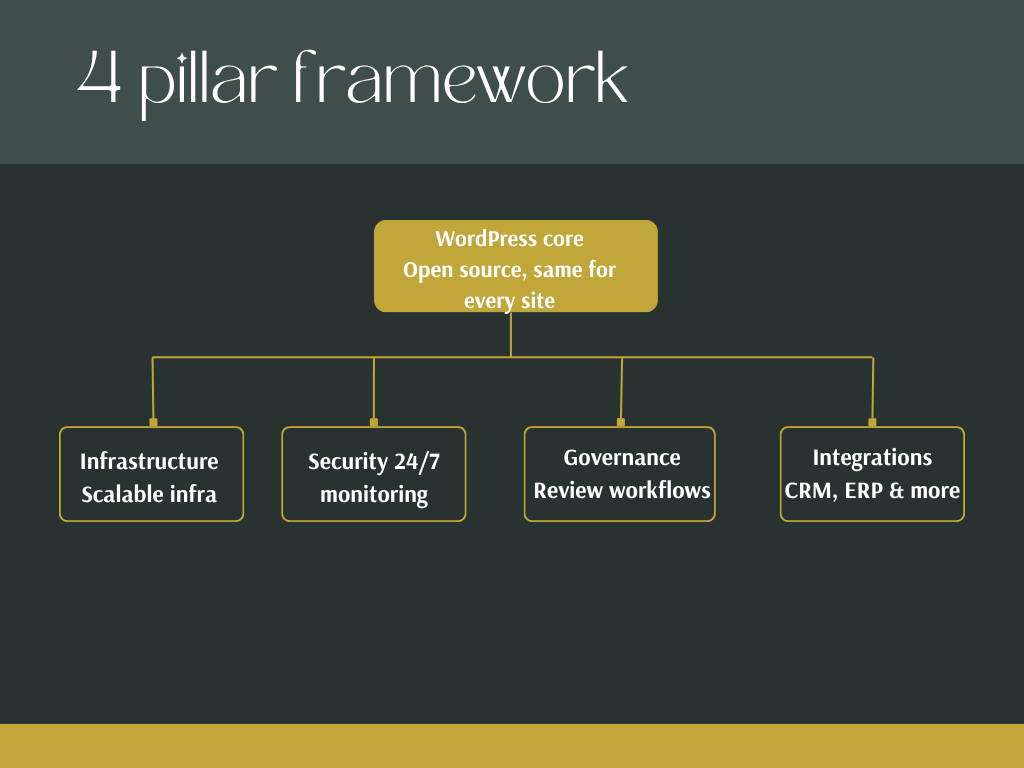
The biggest reason WordPress installs fail isn’t the software. It’s hosting sized for yesterday’s traffic instead of tomorrow’s. It’s security treated as a pre-launch checklist instead of an ongoing discipline. Shared hosting was never built for global, high-concurrency environments. That’s why NASA and the White House don’t run on it. At enterprise scale, WordPress runs on cloud infrastructure with load balancing, CDN delivery, tuned caching, and sometimes a headless architecture. Security also means hardened environments, encrypted hosting, continuous monitoring, and regular audits. The exact requirements depend on the regulatory framework. That’s because “secure” means different things to different industries.
The other half is governance and connectivity. Every large organization faces the same problem. Too many people touch the same website. Marketing wants to publish quickly, legal needs review cycles, Regional teams want autonomy. Without governance, that becomes publishing chaos. WordPress addresses this with role-based access and approval workflows. An enterprise website also can’t operate in isolation. It must connect to the CRM, ERP, and marketing automation stack through governed APIs and middleware. That keeps data flowing both ways and turns the website into a connected part of the business instead of an isolated system.
Why WordPress is Recommended Over Proprietary Platforms
We’re not going to pretend WordPress is the only viable option – Adobe Experience Manager and Sitecore are legitimate platforms with their own strengths. But for the majority of enterprise clients we work with, WordPress wins on the fundamentals that actually matter to a business:
Cost- WordPress typically runs 30-50% cheaper than proprietary alternatives. Because you’re not paying recurring licensing and renewal fees to a single vendor.
Speed- comes from the sheer size of the WordPress ecosystem. Thousands of themes, blocks, plugins, and reusable components help teams move faster. This allows campaigns and features to reach the market quickly.
Ownership- WordPress is open source. Your code and your data are yours. You’re never at the mercy of a vendor’s roadmap, pricing changes, or acquisition.
Talent- The WordPress developer community is enormous. That matters more than people realize. It means you’re never locked into a single agency or a handful of specialized consultants just to keep your platform running.
Here’s how the two approaches stack up on the factors that actually move the needle for enterprise buyers:
Features | WordPress | Proprietary CMS |
Cost | 30–50% cheaper | Recurring licensing and renewal fees |
|---|---|---|
Speed | Faster: Large ecosystem of themes, blocks, plugins | Smaller, more closed ecosystem |
Ownership | Open source, code and data are yours | Tied to vendor roadmap and pricing |
Talent | Enormous developer community | Locked into a few specialized vendors |
The Enterprise WordPress Approach: Lessons from Experience
We’ve inherited projects that were technically on WordPress but were not built to enterprise standards. The patterns are consistent, and they’re the same lessons we now build into every engagement:
Architecture decisions come first. Choosing a hosting provider before you understand your actual traffic and transaction volume is backwards. We start every enterprise engagement through our consulting practice. With an honest assessment of what the platform actually needs to support, before a single line of infrastructure gets provisioned.
Performance is a discipline. Database optimization, caching strategy, and code-level audits don’t stop at launch. They’re ongoing work, which is why we treat performance as a Performance-Optimized Solution. We enable sub-second global delivery through continuous caching, CDN orchestration, and performance budgeting.
Staging has to actually mirror production. We’ve seen too many disasters caused by staging environments that were quietly out of sync with production. Every update we ship for enterprise clients gets validated in an environment that genuinely mirrors what’s live.
Maintenance is a core operational function. Our Enterprise WordPress Support provides proactive monitoring, updates, patches, and uptime management. This lets your team focus on growth instead of firefighting. We structure our maintenance plans from a Starter Maintain tier for simpler needs up to a Tailored Enterprise tier for complex, custom setups. Every plan includes monthly reporting, SSL checks, and e-commerce support.
What This Looks Like in Practice: Wipro Foundation
Here’s one example of these pillars applied to a real enterprise client.
Wipro Foundation, the CSR arm of the global IT enterprise Wipro, partnered with us to rebuild Samuhik Pahal, their digital journal. The brief centered on a genuine enterprise-scale governance problem: years of content was locked in static PDFs, which meant poor accessibility, poor discoverability, and a publishing workflow that couldn’t keep pace with a large foundation’s output. We rebuilt it as a proper WordPress platform, moving that archive into structured, accessible digital articles and improving the overall performance and user experience along the way.
It’s a modest-sounding project on the surface, moving PDFs to web articles. But it’s a good illustration of the point this whole post is making: the hard part of enterprise WordPress usually isn’t the code, it’s the governance, accessibility, and long-term partnership around it. You can read the full breakdown in our Samuhik Pahal case study.
Is WordPress Enterprise Ready?
Yes, provided the organization is ready to treat it like the enterprise asset it can be.
It’s the honest, unglamorous truth we’ve arrived at. It comes from building, migrating, securing, and supporting hundreds of WordPress projects, for organizations that couldn’t afford to get it wrong. The platform gives you the flexibility, the cost efficiency, and the open ecosystem that proprietary systems simply can’t match. What it doesn’t give you automatically is the architecture, governance, and technical discipline that turn “a website” into “mission-critical infrastructure.” That part has to be built.
If your organization is weighing WordPress against a proprietary enterprise CMS, or if you’ve inherited a WordPress platform that’s starting to show the strain of enterprise-level demands, we’d rather have that conversation early than after something breaks in production. Talk to our enterprise WordPress team and we’ll give you a straight answer about what your platform actually needs.

Leave a Reply
Articles
Related Insights.
Blogs and Resources on WordPress, WooCommerce, SEO and Marketing
Leave a
Comment.